
 Memorial Day is more than a welcome 3-day weekend; it is a solemn day honoring all who gave their lives in military service.
For many people, the holiday signals the unofficial start of summer—a time for rest, travel, and gatherings with family and friends. Yet those traditions can make it easy to lose sight of the day’s deeper purpose.
The Uniform Monday Holiday Act of 1971 moved Memorial Day from May 30 to the last Monday in May, turning it into a three-day weekend. In doing so, it shifted attention from remembrance and toward recreation.
As U.S. Air Force veteran Dan Littley said at a 2012 Memorial Day ceremony: “The solemnity of this day has been forgotten. We’ve lost the reason for this holiday and have forgotten the men who made the ultimate sacrifice.” His words remain a powerful reminder of what Memorial Day asks of us.
How Memorial Day Began
Memorial Day was officially established on May 5, 1868, by General John Logan, national commander of the Grand Army of the Republic, an organization of Union Army veterans.
In his proclamation, Logan urged the nation never to forget the cost of preserving a free and united republic.
The first Memorial Day was observed on May 30 of that year with flowers placed on the graves of Union and Confederate soldiers at Arlington National Cemetery. What began as a day to honor Civil War dead later expanded to remember Americans who died in all wars,
Moina Michael and the Red Poppy
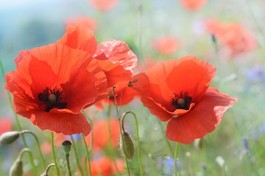
One of the most enduring Memorial Day symbols is thanks to Moina Michael, a young teacher deeply moved by World War I. After President Woodrow Wilson announced America’s entry into the war in 1917, she resolved to support soldiers and help ensure they would never be forgotten. Part of her inspiration came from a poem she’d discovered.
Penned by Canadian physician Lieutenant-Colonel John McCrae after the funeral of a fellow soldier in 1915, “In Flanders Fields” honored those who died on the battlefields of Flanders and fixed the poppy as a symbol of sacrifice for all time. The poem closes with these well-known lines:
“If ye break faith with those who die,
We shall not sleep, though poppies grow
in Flanders Fields.”
Red poppies did, in fact, grow over the graves of the fallen soldiers, and through Ms. Michael’s efforts, the red poppy became a national symbol of remembrance and support for veterans. The sale of poppies raised millions of dollars for veterans, war widows, and orphans. When she died on May 10, 1944, veterans honored her by weaving 3,223 poppies into a blanket for her grave.
Today, red poppies are distributed on both Memorial Day and Veterans Day. Wearing one can serve as a simple act of gratitude—and a reminder of Moina Belle Michael, the lives honored each year, and the true purpose of this day..
~ With thanks, Carol


